Check Where Braille Goes and How It Is Marked Under Korea's New Cosmetics Guideline
Key Takeaway
On October 20, Korea's Ministry of Food and Drug Safety (MFDS) issued its Guideline on Braille Labeling for Cosmetics. Braille carries the product name and should not overlap regular print.
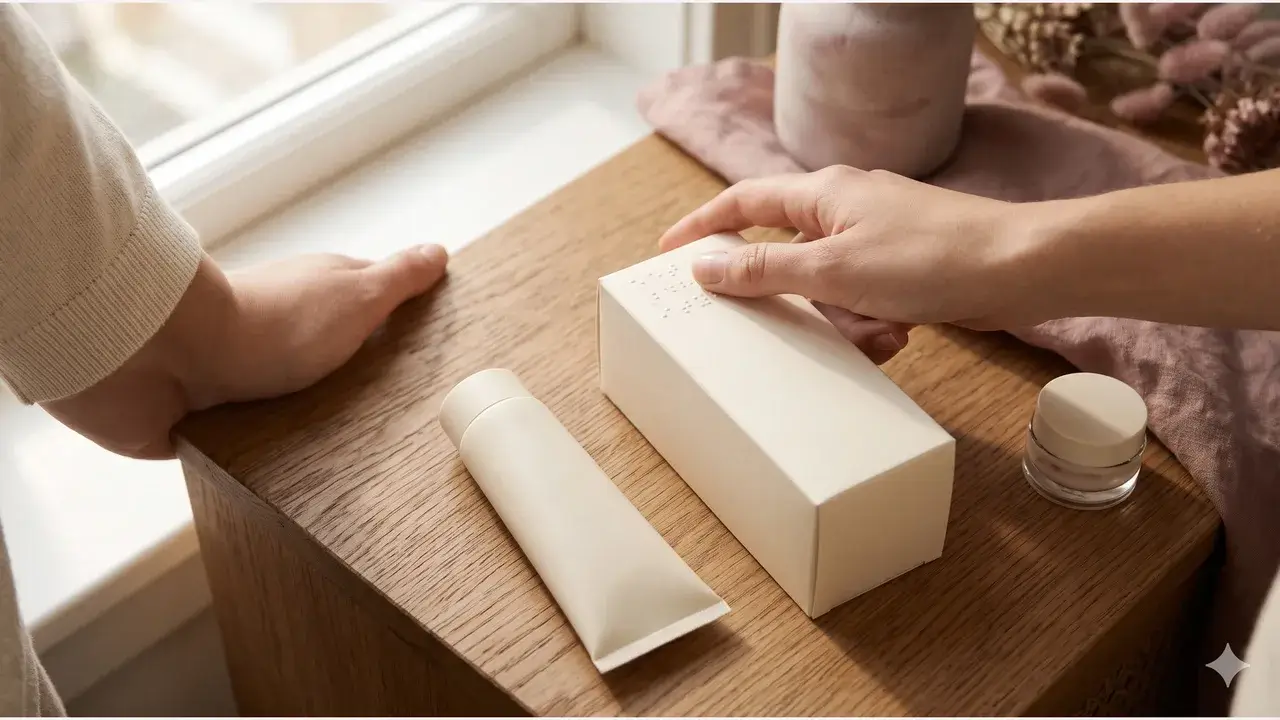
This article covers the issue date, what the braille shows and how it is made, where to find it on a pack, and what the coverage does not say.
When and how was this guideline issued?
The MFDS said it will publish a standard approach to braille marking and recognize good examples to spread the practice. Cosinkorea reports that the guideline aims to promote braille and audio or sign-language video codes on containers and packaging for visually and hearing impaired users. An August 10 report said a draft had gone out for public notice, with industry comments accepted until August 31.
| Item | What the announcement and coverage say | Where it was confirmed |
|---|---|---|
| Issuing body | Ministry of Food and Drug Safety | Policy Briefing |
| Name | Guideline on Braille Labeling for Cosmetics | Policy Briefing |
| Issue date | October 20 | Policy Briefing, Cosinkorea |
| Structure | General provisions, braille marking, audio and sign-language video codes | Cosinkorea |
| Guideline effective date | Not stated in the coverage reviewed | Policy Briefing, Cosinkorea |
| Full text | Search for the guideline's title among the civil-petitioner guides under the law and materials menu on the MFDS website | Policy Briefing |
Checked on October 23, 2026.
What does the braille show and how is it marked?
According to Policy Briefing, the braille shows the cosmetic's name. Showing only part of the name rather than the whole is also possible.
| Item | What the guide says | Where it was confirmed |
|---|---|---|
| What is shown | The cosmetic's name, partial display allowed | Policy Briefing |
| Methods | Molding, embossing, stickers, braille tags and similar | Policy Briefing |
| Unit | Marking each minimum sales unit is recommended | Policy Briefing |
| Proofing | Review by a braille transcriber or proofreader is recommended | Policy Briefing |
Cosinkorea reports that the name is shown first and that directions for use are considered as an addition. The August draft reportedly said that when space is tight, a partial name should still let people tell products apart, and that a functional-cosmetic phrase and directions for use could also be shown. The coverage reviewed does not say how the final guideline handles this.
Where on the pack should you feel for it?
According to Cosinkorea, braille goes at the top of the main panel in principle, and at the upper right when the top has distinct left and right sides. Policy Briefing says braille goes where regular print appears, without overlapping it. The reports word this differently, so it is worth checking both spots.
The way braille is made also depends on the container. Cosinkorea reports the following.
- Embossed (perforated) braille comes first. It is pressed from the back so the front rises, which leaves the back recessed.
- Plastic tube bodies, thin film pouches and film casings use stickers, braille tags or clear embossed braille.
Dot size and spacing figures are not given in the coverage reviewed.
Does every cosmetic carry braille?
The coverage reviewed does not say that marking is mandatory. Cosmorning's August report says any cosmetic may carry braille or audio and sign-language video codes. Policy Briefing talks about a standard approach and spreading good examples, not an obligation.
Cosinkorea reports that industry voices say container sizes vary so widely that applying braille is difficult, and that electronic labels (e-labels) should be used more. The coverage reviewed does not give details on how the audio and sign-language video codes are displayed.
What should you check before buying?
- Run a fingertip over the top front of the pack and its upper right for raised dots.
- On tubes and pouches, look for a sticker or braille tag instead of marks on the body.
- Check that any dots sit clear of the area where regular print appears.
- If the product page does not mention braille, give the seller's customer service the product name and container type and ask.
- When you cannot tell how much the braille covers, read the full ingredient list and precautions separately on the regular printed label.
If redness or itching appears after use, stop using the product and consult a professional. Braille may differ from product to product, so if you are buying a gift, feel the pack yourself or ask the seller before you buy.
Frequently Asked Questions
What does the braille say?
Policy Briefing says the braille shows the cosmetic's name, and showing only part of the name is allowed. Cosinkorea reports that the name comes first, with directions for use considered as an addition.
Does every cosmetic carry braille?
The coverage reviewed does not say braille is mandatory. It says braille or codes may be added alongside regular print, and that the ministry plans to spread good examples.
How can I find products that have braille?
The coverage reviewed has no list of products that use braille. Feel the top of the main panel and its upper right with your fingertip, and ask the seller if it is unclear.
Sources & Verification Date
- Policy Briefing, Ministry of Food and Drug Safety: Spreading braille more widely for safe cosmetics use · Verified
- Cosinkorea: Guideline on braille labeling for cosmetics issued, with marks kept clear of regular print · Verified
- Cosmorning: Braille labeling guideline for visually and hearing impaired users drafted · Verified
All materials have been verified from official announcements and may have changed since verification.